
Every enterprise channel leader knows the pattern.
You invest in a top-tier Partner Relationship Management (PRM) platform, plug in a Through-Channel Marketing Automation (TCMA) tool, and connect your Customer Data Platform (CDP) to your CRM. Yet, when the Quarterly Business Review (QBR) arrives, partner portal login rates sit in single digits, shared campaign adoption is dormant, and attributed channel revenue remains flat.
The immediate impulse is to blame the software or shop for another vendor. But as Martec’s Law reminds us, technology capabilities evolve exponentially while human organizational capacity evolves linearly.
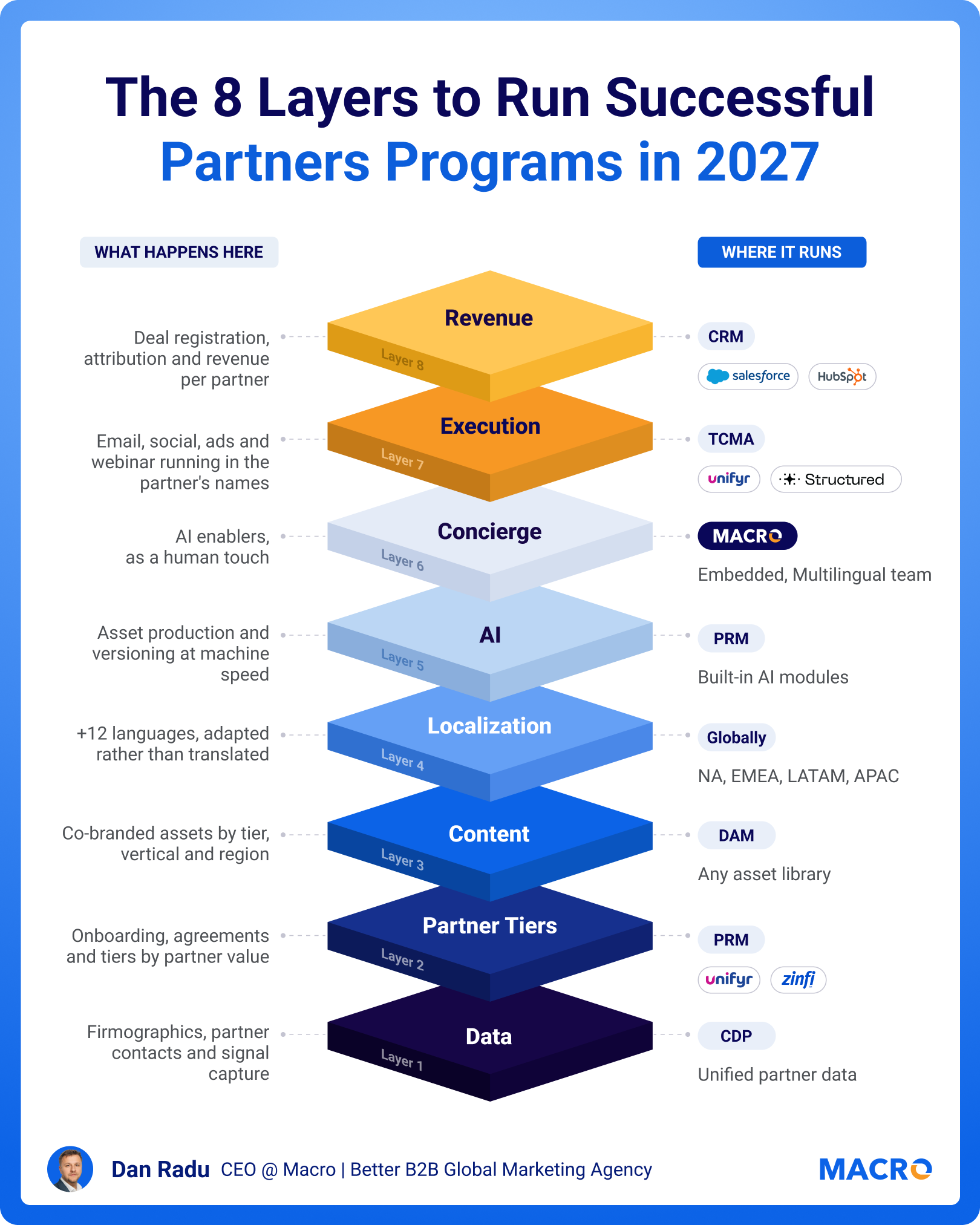
To help global B2B organizations solve this operational disconnect, Dan Radu, CEO at Macro, developed The 8 Layers to Run Successful Partner Programs in 2027.
True partner yield isn't built by buying another tool. It is unlocked when every layer of your partner architecture, from raw data capture to human concierge enablement, is fully operationalized.
Layers 1-3: The Core Infrastructure (Data, Tiers, and Content) [Layers 1-3: Data, Tiers, and Content]
Three structural layers form the foundation of any enterprise partner ecosystem:
- Layer 1 (Data): Collect firmographics, partner contact signals and intent data in your CDP.
- Layer 2 (Partner Tiers): Automate onboarding, legal agreements, and tier structuring in your PRM (e.g., Unifyr or Zinfi).
- Layer 3 (Content): Tier, vertical, and region co-branded assets housed in a Digital Asset Management (DAM) library.
Most channel operations spend 80% of their annual budget perfecting these three bottom layers. But without cross-layer alignment, tactical execution breaks down instantly.
Hypothetical Execution Gap: The Munich Disconnect
Consider a tier-one Managed Service Provider (MSP) based in Munich, Germany. Your PRM also automatically moves them up to “Gold Partner” status (Layer 2) and unlocks a set of enterprise cloud migration whitepapers in your DAM (Layer 3).
However, because your CDP (Layer 1) failed to capture their specific DACH healthcare compliance focus, the system pushes generic English-language finance templates. The partner logs into the portal once, finds zero relevant materials for their local pipeline, and never returns. The software worked perfectly; the execution failed.
Layers 4–5: The Scale vs. Adaptation Dilemma (Localization & AI) [Layers 4–5: Localization & AI]
To expand globally, enterprise brands attempt to scale asset creation using modern automation:
- Layer 4 (Localization): Adapting messages across 12+ languages for NA, EMEA, LATAM, and APAC.
- Layer 5 (AI): Generating asset versions and campaign variations at machine speed via built-in PRM AI modules.
Generative AI allows marketing teams to produce thousands of co-branded banners, email sequences, and landing pages in seconds. However, speed without regional nuance creates market friction .
Hypothetical Implementation Gap: The Bogota The Translation Trap
A North American channel team uses built-in or default PRM AI modules (Layer 5) to instantly translate a new cybersecurity campaign into Spanish for LATAM partners.
So when a key reseller in Bogota, Colombia tries to deploy the campaign, they realize that the AI did a literal translation of North American enterprise jargon. The copy sounds synthetic and culturally tone-deaf to the local buyers. Lacking the bandwidth or internal designers to rewrite the campaign, the Bogotá partner abandons the initiative.
Layer 6: The Missing Engine (The Partner Marketing Concierge) [Layers 6: Partner Marketing Concierge]
This brings us to the most critical layer in the 2027 stack: Layer 6 (Partner Marketing Concierge).
Layer 6 is the human bridge between the capabilities of technology and the adoption of partners. Sitting directly above AI asset generation, an embedded, multilingual concierge team acts as the human enabler.
While AI modules generate content variations at machine speed, human concierges read the room. They ensure campaigns are culturally adapted rather than merely translated, train regional partner teams in their local language, and provide hands-on administrative support.
Without Layer 6, Layers 1 through 5 generate high-volume assets that sit idle in portals, while Layers 7 and 8 suffer from stalled adoption.
Layers 7–8: Activation & Attribution (Execution & Revenue)[Layers 7–8: Execution & Revenue]
The ultimate objective of any channel ecosystem sits at the top:
- Layer 7 (Execution): Running co-branded email, social, ad, and webinar campaigns directly in the partner’s name via TCMA tools (such as Unifyr or StructuredWeb).
- Layer 8 (Revenue): Tracking deal registration, multi-touch attribution, and partner-sourced revenue inside your CRM (Salesforce or HubSpot).
Hypothetical Gap in Execution: The Tokyo Lead Leakage
A valued partner in Tokyo, Japan has agreed to host a joint executive webinar. They attempt to configure the campaign inside your TCMA platform (Layer 7).
Because your internal team lacks Japanese-speaking technical support, the partner misconfigures the lead-routing webhooks. High-intent registrant leads sit unassigned in a secondary database rather than syncing to your CRM (Layer 8). Six months later, leadership reviews revenue attribution dashboards, concludes the APAC partner program is underperforming, and threatens to cut the regional budget.
Stop Buying Software. Start Funding Execution.[Stop Buying Software, Focus on Execution.]
If your channel revenue is lagging, the solution is rarely replacing your PRM or adding a ninth software tool. The solution is investing in the human execution layer required to make your existing stack run.
At Macro, we act as your embedded Partner Marketing Concierge. We take over the day-to-day administration of your PRM, TCMA, and CRM systems, providing multilingual, in-region support that turns shelfware into measurable pipeline.